Pythagorean Theorem Guide: Formula and Examples
The Pythagorean theorem is the main bridge between right-triangle shape and side-length numbers in school geometry. If you can confirm that an angle is 90 degrees, the theorem gives you a reliable way to find a missing side or to test whether three lengths can form a right triangle. This page explains the core formula, several worked cases, a short word-problem style setup, and the mistakes that usually cause test-day errors on problems that are not actually “hard” mathematically.
The theorem does not work on arbitrary triangles. It is specifically about right triangles, with the long side (hypotenuse) opposite the right angle. That restriction sounds obvious, but most classroom mistakes happen when students apply the same letter pattern in a picture that is not a right triangle, or they label c incorrectly in a nonstandard drawing.
Why this theorem shows up in so many classes
Students meet the Pythagorean theorem in coordinate distance, in similar triangles, in basic trigonometry, and in many “real world” word problems. It is a stable reference rule: once you are sure a triangle is right, you are allowed to use a^2 + b^2 = c^2 to relate the three sides.
Another way to use the same numbers is a converse check. If the three side lengths satisfy a^2 + b^2 = c^2 for the longest side c, the triangle is right. That idea helps with proof-style questions and with shortcuts on multiple-choice problems when a diagram is drawn to scale but not fully labeled with angles.
The formula and what each letter must mean
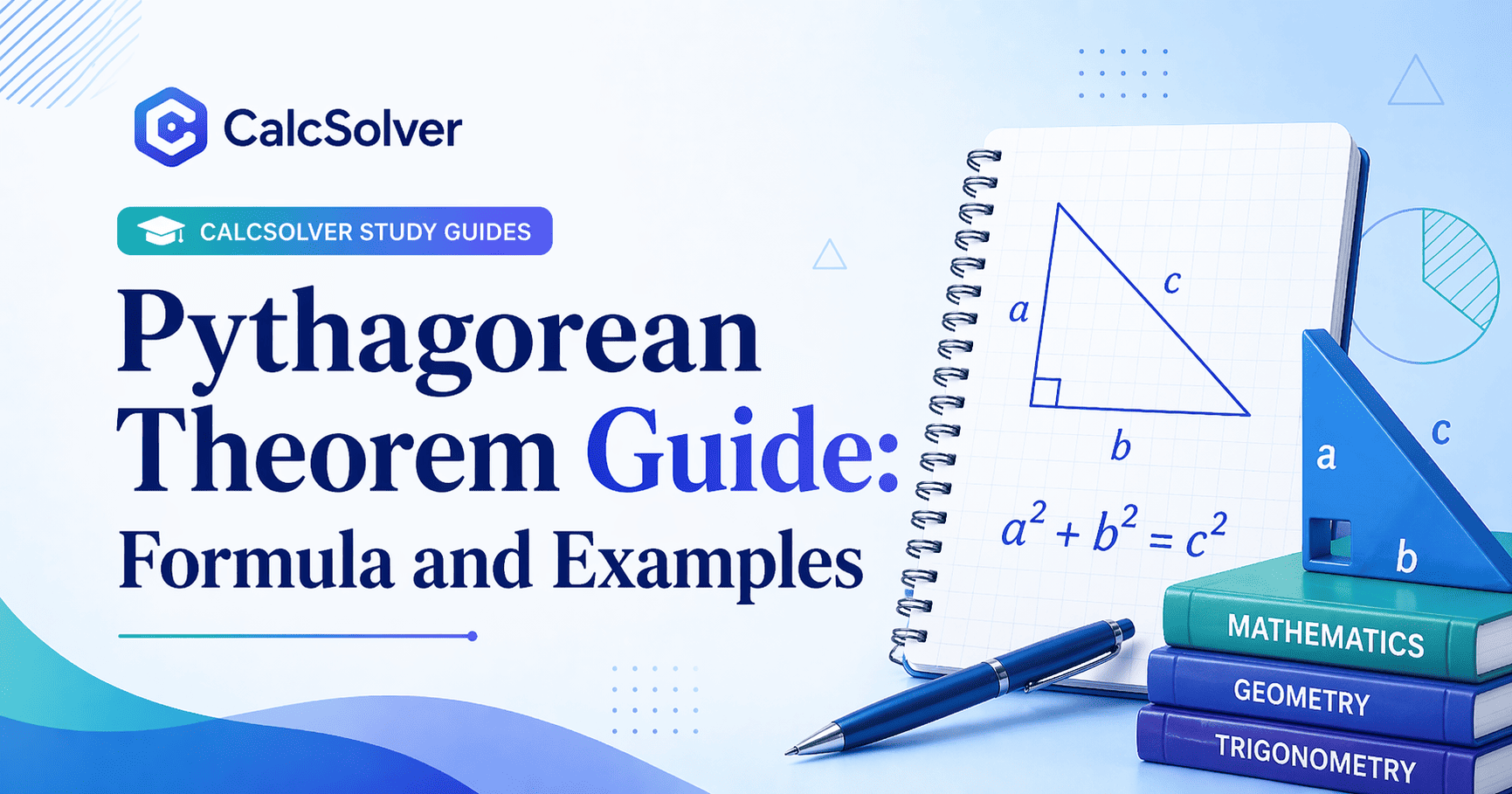
For a right triangle, label the two legs a and b, and the hypotenuse c. The hypotenuse is always opposite the 90° angle and is the longest side. The relationship is a^2 + b^2 = c^2. To solve for c, you add the squares of the legs and take the (principal) square root. To solve for a leg when the hypotenuse and the other leg are known, you rearrange, for example a^2 = c^2 - b^2 and then a = sqrt(c^2 - b^2).
When you do homework on paper, you should keep one habit: identify c before you substitute anything. If you are solving for a leg, the unknown you want is on the “smaller” side of the equation after you isolate the square. If you are solving for the hypotenuse, you expect c to be larger than either given leg, which is a quick plausibility check after you compute a numeric value.
Worked examples with numeric flow
Example 1 (legs to hypotenuse). If a = 3 and b = 4, then c^2 = 9 + 16 = 25 and c = 5. This is the most common “starter” 3-4-5 right triangle, and you should know it the way you know basic multiplication facts because it reappears in similar figures and scaled models.
Example 2 (hypotenuse and one leg to the other leg). If c = 13 and b = 12, then a^2 = 169 - 144 = 25, so a = 5. Notice that the arithmetic is a subtraction step before a square root. A frequent mistake is to subtract the wrong order or to forget the square on c.
Example 3 (converse check). Given sides 5, 12, 13, test whether the triangle could be a right triangle with 13 as the longest side. Compute 5^2 + 12^2 = 25 + 144 = 169 = 13^2. The equality works, so these lengths are consistent with a right triangle. If the two shorter squares did not add to the largest square, you would not have a right triangle from those three lengths with that assignment of longest side.
Example 4 (messier numbers, same structure). If a = 1.5 and b = 2, then c^2 = 2.25 + 4 = 6.25, so c = 2.5. Decimals and fractions require careful calculator entry, not a new rule, which is why practice with the structure matters more than memorizing a single “nice” 3-4-5 case.
Word problem angle: from language to a right-triangle model
Many “ladder against a wall” and “distance from first base to home across the diamond” problems are really the same model: a right angle appears because two directions are perpendicular, and a missing distance is a side of a right triangle. Your job is to extract which segments are the legs and which segment is the hypotenuse from the story, not to memorize new formulas.
A useful routine is: sketch a small diagram, mark the right angle, label known lengths, then match those labels to a, b, and c. Once the picture matches the equation form, the remaining work is the same as the numeric examples above. If a problem gives two distances and asks whether a corner is “square,” the converse test is often what the question wants.
Common mistakes
Wrong triangle type. Using the Pythagorean relationship on a triangle that is acute or obtuse, or when you do not actually know a right angle is present, produces false conclusions.
Wrong side as c. If you treat a leg as the hypotenuse, your equation no longer models the same triangle. The hypotenuse must be the side opposite the right angle, not the “bottom” of the picture.
Square root too early or in the wrong place. You add a^2 + b^2 as complete squares, then take one square root to find c. A related mistake is to distribute a square root over a sum, which is not valid algebra.
Sign errors in rearrangement. When you compute c^2 - b^2, a small sign slip gives a different magnitude under the square root. Always ask whether the missing side length is smaller than c, as expected for a leg.
Unit inconsistency. Mixing feet and inches or meters and centimeters without conversion leads to a number that is technically calculated but not meaningful. Convert first, then apply the theorem.
FAQ
Does the theorem work for 3D distances?
Not with this one equation alone. The Pythagorean theorem is for right triangles in a plane. A longer diagonal in a box needs an extension, often a double use of the theorem or a three-dimensional distance formula.
Can a triangle have sides 2, 3, 4 and still be a right triangle?
Test the longest side as c: 2^2 + 3^2 = 4 + 9 = 13, and 4^2 = 16. The sums do not match, so these lengths are not a Pythagorean right-triangle triple in that order.
Is the answer ever negative?
Side lengths are positive, so you take the positive square root. If a calculation under the square root is negative, you have either mislabeled sides or a problem that is not a valid real triangle in that configuration.
How does this connect to the distance formula in coordinates?
Horizontal and vertical change between two points form a right triangle, and the distance is the hypotenuse. The distance formula in the plane is structurally a Pythagorean calculation.
Related tools and next reading
Use the Pythagorean Theorem Calculator to check missing sides once your triangle model is set up. Use the Scientific Calculator for square roots and exponents, and the trigonometry calculator guide if your course also expects sine and cosine in right-triangle work. If you are moving between the theorem and other algebra, the quadratic formula examples article is a good companion because factoring and the quadratic formula often appear in the same chapter sequence.
Applied learning context
How this topic appears in real coursework
In real classes, this topic usually appears inside mixed assignments instead of in isolation. Students may need to combine definitions, formulas, and interpretation in a single response, which is why practicing only one template answer is often not enough. A stronger routine is to check what the question is really asking, identify the required variables, then map the setup to the correct method before calculating.
Common reasoning traps and how to prevent them
The most frequent mistakes happen before arithmetic starts: reading symbols too quickly, mixing units, applying the wrong formula, or skipping assumptions. To avoid this, write a short pre-check line for each problem: identify known values, unknown values, constraints, and expected answer size. This one-minute habit prevents many avoidable errors and improves final answer quality more than repeated button pressing.
How to self-verify before submitting answers
After solving, verify by estimation and by method. Estimation checks whether the result is in a plausible range. Method checks whether each step still matches the original question intent. If either check fails, revise the setup first instead of retyping numbers. This approach builds transferable problem-solving skill, not just short-term answer accuracy.