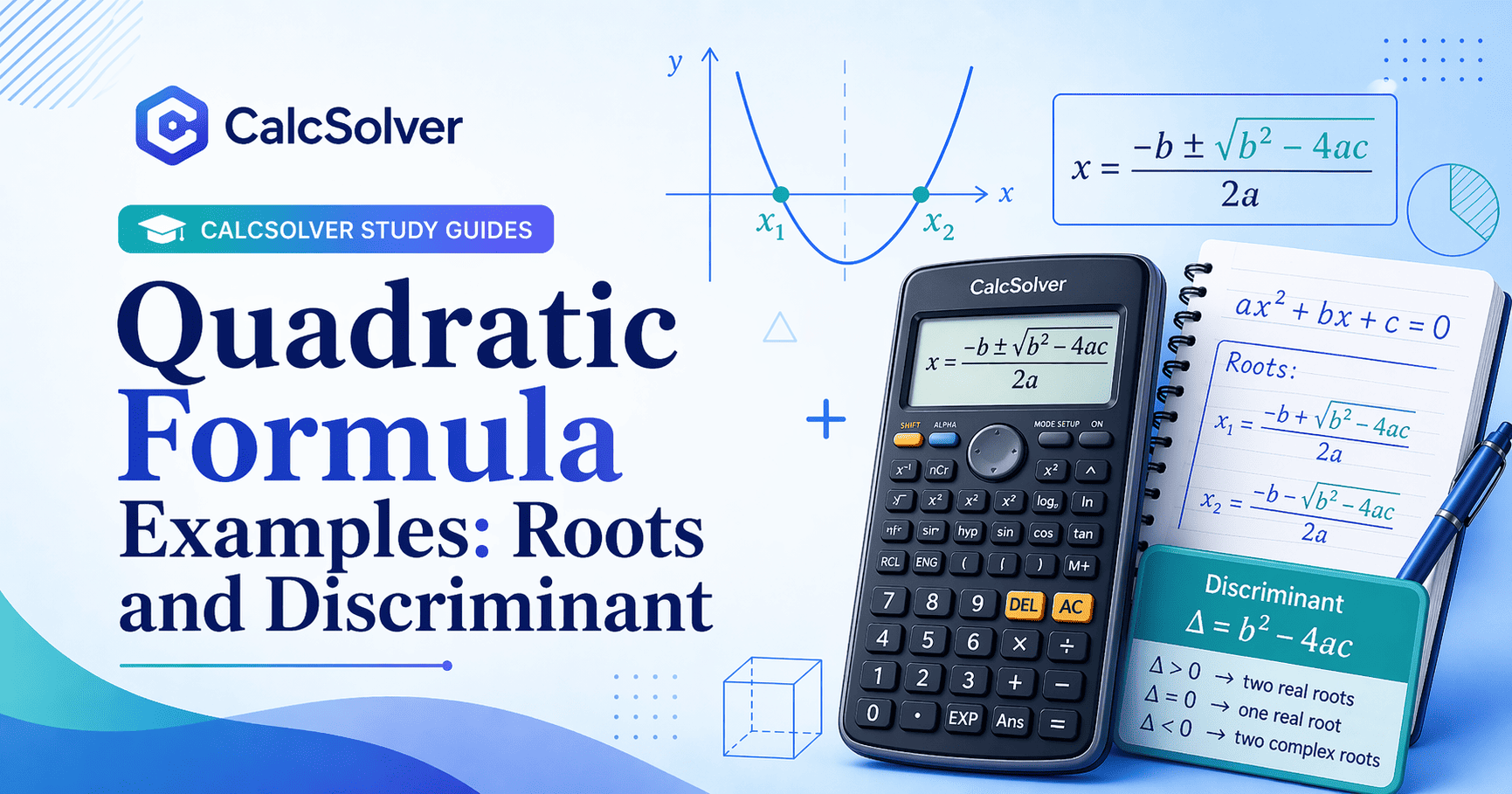
Quadratic Formula Examples: Roots and Discriminant
The quadratic formula solves equations that look like ax^2 + bx + c = 0 with a not equal to 0. The title of this page names two things you should be able to work with: examples of finding roots, and the discriminant, the piece under the square root that tells you what kind of solutions you can expect before you finish every arithmetic step. Together, the formula and the discriminant are the “always works” method when factoring is messy, when coefficients are not integers, or when you need to detect repeated roots and non-real solutions in later algebra.
This page is not meant to replace your textbook’s proof, but to give a reliable workflow: rewrite in standard form, name a, b, and c correctly (including their signs), compute the discriminant, interpret it, and then use the full formula. If you follow that order, the examples stay organized even when the numbers are ugly.
When the quadratic formula is the right tool
Factoring is often faster when a quadratic factors cleanly, but the formula still applies to the same problem. The formula is especially important when the quadratic does not factor nicely over the integers, when you are allowed a calculator, or when a problem asks for “exact form” in a way that still ends up in radicals. It is also the standard back-up for checking factoring, because a wrong factorization will usually not satisfy the original equation at all.
If your course is moving into complex numbers, the same formula continues to work; the only new idea is that a negative discriminant can produce a square root of a negative number, which is handled with imaginary units in that chapter. The structure of the work does not change, only the number system you are allowed to use for the last step.
Standard form before you name a, b, and c
Standard form means one side of the equation is zero, and the other side is ax^2 + bx + c. If a worksheet gives 2x^2 = 5x - 1, you must move terms so that the equation reads 2x^2 - 5x + 1 = 0 (or an equivalent form with the same zero) before you read off a, b, and c. A common trap is a positive constant on the wrong side, which flips a sign in c, which then changes the whole discriminant.
Be careful with subtraction: if the equation is x^2 - 5x + 6 = 0, the linear coefficient b is -5, not 5, unless you have reorganized the entire equation differently. Your grade often depends on whether you can track a negative b inside -b in the formula without hand copying errors.
The formula and the discriminant
The solutions are x = (-b +/- sqrt(b^2 - 4ac)) / (2a). The sub-expression D = b^2 - 4ac is called the discriminant. The discriminant is useful because you can read it before you take every square root in full detail, at least in real-number courses, to predict two distinct real roots, one repeated real root, or no real roots (two non-real complex conjugate roots) depending on the sign of D, under the usual high-school convention.
Remember that the entire numerator is -b plus or minus the square root term, and that the denominator is 2a for both roots. A frequent algebra mistake is to divide only part of the numerator by 2a, which breaks the structure of the formula.
How to read the discriminant in basic courses
If a, b, and c are real and you are only looking for real x, then: if D > 0, the quadratic has two different real roots; if D = 0, the quadratic has one repeated real root; if D < 0, the quadratic has no real roots, which is the situation where a graph does not cross the x-axis. These statements explain why some exercises ask for D first as a “without solving fully” check.
When you have D = 0, you still use the same formula, but the plus and minus branches give the same value, which is the repeated root. When D is a perfect square and positive, you often get rational roots, which is one way factoring and the formula can agree nicely.
Worked examples: from clean integers to a repeated root
Example 1 (integer coefficients, two real roots). Solve x^2 - 5x + 6 = 0. Here a = 1, b = -5, c = 6. Then D = 25 - 24 = 1, so the roots are (5 +/- 1) / 2, which is 3 and 2. You can factor the same equation as (x - 2)(x - 3) = 0, which is a good cross-check of the method.
Example 2 (repeated root). For x^2 + 4x + 4 = 0, a = 1, b = 4, c = 4, so D = 16 - 16 = 0. The single repeated root is x = -4 / 2 = -2, which matches the perfect square (x + 2)(x + 2) = 0.
Example 3 (non-monic leading coefficient). For 2x^2 - 7x + 3 = 0, a = 2, b = -7, c = 3. D = 49 - 24 = 25, so the roots are (7 +/- 5) / 4, giving 3 and 0.5. The extra 2a in the denominator is what students most often miscalculate, so it helps to write the fraction as a single line before you simplify.
Example 4 (negative discriminant, real-coefficient preview). The equation x^2 + x + 1 = 0 has D = 1 - 4 = -3, so in a real x-only class you report “no real solutions” after showing D < 0. A complex-number course will instead express solutions using the square root of -3, but the first correct diagnostic is still the discriminant sign check.
Factoring compared with the formula
Factoring is a forward step when you can see integers quickly, but the formula is a universal back end. A smart workflow is: try factoring for speed when practice calls for it, then use the formula to verify when time allows, especially when a problem answer looks surprising. The discriminant is the bridge language between “there should be two nice roots” and “this quadratic was designed to be ugly.”
If a problem instructs you to use the formula specifically, you should show a, b, c, the discriminant, and the final simplified roots even if you already noticed the factors mentally. The method matters for partial credit, not just the final x-values.
Common mistakes
Sign errors on b. A negative b inside -b is easy to copy wrong when you are tired. A quick fix is to circle b on the original standard form and carry that sign to D and to the numerator as one consistent object.
Not converting to standard form first. A hidden sign on c from rearranging an equation is enough to make D wrong by a lot.
Misplacing 2a. The denominator applies to the entire numerator, not to only the square root part.
Stopping at the discriminant when the question asked for roots. D answers “what type,” and you still have to return to the full formula to answer “what numbers” unless a question limits what you should report.
Confusing “no real roots” with “no solution.” In a complex number course, there are still two complex solutions; in a real x-only class, the correct statement is that there is no real solution.
FAQ
Can a be negative?
Yes. The formula is still valid, but the sign of a shows up in the denominator and in some cancellation patterns. It does not change the definition of the discriminant.
What if the problem gives a quadratic in vertex form?
Expand, collect like terms, and move everything to one side to reach standard form before you read a, b, and c, unless the question asks a graph feature that vertex form already reveals.
Is the square root in the formula always a perfect square number?
No. D can be a positive non-square, in which case answers stay in radical form, or a negative number in a complex-number setting.
How does this connect to polynomial division or factoring chapters?
Roots of the quadratic match linear factors, which is the same fact family used in the factoring polynomials guide. If a quadratic is one factor in a larger expression, the same a, b, c identification rules apply to that quadratic piece only.
Related tools and next reading
Use the Quadratic Formula Calculator to check your arithmetic after you have written the method on paper. The Algebra Basics Calculator helps for linear work when you are rearranging a messy equation into standard form, and the Essential Algebra Formulas guide is a good compact reference while you are studying. For geometry that appears in the same course sequence, the Pythagorean theorem guide pairs well when distance and right triangles show up in word problems with quadratics.
Applied learning context
How this topic appears in real coursework
In real classes, this topic usually appears inside mixed assignments instead of in isolation. Students may need to combine definitions, formulas, and interpretation in a single response, which is why practicing only one template answer is often not enough. A stronger routine is to check what the question is really asking, identify the required variables, then map the setup to the correct method before calculating.
Common reasoning traps and how to prevent them
The most frequent mistakes happen before arithmetic starts: reading symbols too quickly, mixing units, applying the wrong formula, or skipping assumptions. To avoid this, write a short pre-check line for each problem: identify known values, unknown values, constraints, and expected answer size. This one-minute habit prevents many avoidable errors and improves final answer quality more than repeated button pressing.
How to self-verify before submitting answers
After solving, verify by estimation and by method. Estimation checks whether the result is in a plausible range. Method checks whether each step still matches the original question intent. If either check fails, revise the setup first instead of retyping numbers. This approach builds transferable problem-solving skill, not just short-term answer accuracy.